Who Is Your Audience?

“Know your audience.” It’s the first rule of good communication. Whether you are a novelist, a journalist, or a public speaker, you have to know the nature of the audience you are addressing. Misunderstand your audience, and they will turn on you. Sometimes viciously.

But there are unintended audiences as well, and the most sophisticated communication takes them into account, because they can turn on you too. Consider the following video. It was prepared by the USA Bid Committee, acting on behalf of the United States Soccer Federation. The Bid Committee works to secure a bid to host the World Cup in 2018 or 2022. The audience is the members of the World Cup site selection committee, members of FIFA, the world governing body of soccer.

But there is a secondary audience. You don’t bring in Morgan Freeman to narrate and include President Clinton, Mia Hamm, and Spike Lee only to reach a couple of dozen deciders. No, the audience is much larger, and there is a great lesson here for organizations of all sizes and purposes.

When I watch this video, I feel a surge of pride in my country. The secondary audience for this video is fans of the U.S. National team, fans of soccer, and fans of sports. If you read the comments on You Tube, you see the pride the video generates. As someone said, “You had me at Morgan Freeman.” The result of that pride is increased energy and excitement for the support of the bid and greater fan support.

Put this in the context of your organization. Do you share your communication and marketing materials within your company? Do you let your employees experience the pride of their efforts? They are your biggest fans, and when you prepare marketing materials, you have the benefit of reaching your secondary audience. The consequences of this are all positive:

  1. Employees and staff can take pride in their accomplishments and see how they are valued through the representation of your product or service.
  2. You reinforce the mission and vision of your organization internally. The Bid Committee’s message is simple and delivered in Morgan Freeman’s fabulous voice, “We are the world’s home away from home.” That’s America’s vision.
  3. You give your stakeholders the language to speak about your company or organization. “The world is in us.” “Bring it to my country.” “My country loves this game.” “Bring the World Cup to the United States.”

When people take pride in their organization, they share that pride with friends and families. Your audience grows. No matter what size your business is, you can spread your influence further by ensuring that your employees have pride in their efforts.

The Value of Branding Your Expertise

If you listen to the marketing experts, you hear lots of advice about getting on social media—Twitter, Facebook, LinkedIn—and extending your brand. Through that, you drive traffic to your website where you convert those prospects into leads and, eventually, those leads into sales. Most of that advice seems to draw on the examples of business-to-consumer (BtoC) marketing. In other words, the value of the marketing is wrapped up almost completely in the number of leads.

You establish your brand as a source of expertise. Experts are reliable, forward-thinking, trustworthy and provide answers to difficult problems.

Most people walking into McDonald’s can afford the meal, so the quality of the lead matters little.

In business-to-business marketing, the story is different. Almost without exception, every seller in the building product supply chain is offering a product of considerable cost. And every buyer in the chain is a business, not a consumer. Leads are valuable, but they have to be the right kind of lead—a qualified lead.

In recent years, with social and electronic media driving much of the leads, there has arisen one particular technique that can help move those leads to qualified leads. After all, few construction companies are interested in a website visit from a 14-year-old boy.

So how do you get a qualified lead? You establish your brand as a source of expertise. Experts are reliable, forward-thinking, trustworthy and provide answers to difficult problems. In the construction world, those attributes are highly prized. Even more importantly, they are attributes that buyers worry their seller may not have.

Social media provides a unique pathway for you or someone in your company to establish him or herself as an expert. Through blog posts, answering questions on aggregator websites, comments on LinkedIn groups and a whole variety of media, you can position yourself as an expert with deep knowledge of your craft. The reason this is so important is that all of those media outlets are searchable.

When someone searches in your area of expertise, your name begins to be associated with it.

What are the benefits? One benefit is that journalists are often the people using those searches, and when they find your name, you can become a source for them, giving you another platform. That can include print media, but also speaking at conferences and other venues.

More importantly, though, buyers who see sellers as experts trust them more. Trust brings further benefits. The cost of sale goes down because trust means you don’t have to spend as much time gaining it during the sales process. It can also translate into higher profit margins. Buyers—both consumers and business consumers—will pay more for a product or service they have confidence in. Doubt that? Ask yourself why Apple products cost more. 

There are downsides to this. First, establishing yourself as an expert can take time from tasks—such as managing your company—that you may value more. The return on this investment is not as straightforward and it takes longer to see a payback.

Another concern is if the expert in your company is not you but an employee. In that case, the employee is implicitly tied to the value of your brand. Losing such an employee means not only losing their expertise, but it also means a hit to your brand, lowering your company’s value. Such a personnel situation needs careful management and open discussion.

Still, the benefits of establishing your company as the go-to source for information and expertise about your particular niche will increase your value, improve your profitability and help convert more leads into customers. Social media is a great tool for doing that.

SOTW: Number 7

Honda UnicycleLast Wednesday, Honda debuted the U3X, a motorized unicycle that self balances, can move in any direction, and lets you sit at eye level.

It is an divine axiom of good writing that you describe the world around you using your senses. As readers, we want to hear, smell, see, feel, and taste our environment because that’s what gives us the full meaning of the place we’re describing. Hemingway’s short story, “A Clean Well-Lighted Place” carries that axiom in its very title. Hemingway’s writing itself was the perfect example of the greatness of this concept.

But the copywriters for the Honda U3X–competitor for the much more popular Segway–seem to have lost their way in their own surroundings. Clearly, they’re trying to differentiate from the Segway and its elevated position for the rider, putting the user above the masses in the same way that a horse placed the nobility above the peasants. But to describe this position as placing a person at “eye level” is clearly wrong.

Why? Lots of reasons.

  • Eye level changes depending on our own position. So a Segway puts a person at eye level as much as the U3X. 
  • From the image, it’s clear that the eye level of the user is below that of where she would be if she were standing. So, by their ideal, the U3X places the person below eye level. Not the message they want to send.
  • If I’m sitting at eye level, as the copy suggests, am I really at eye level?
  • Museums and contractors put paintings and mirrors at eye level. This is a tenet of good design. But as a taller than average person, I find museum installations and residential mirrors to be anything but eye level.
  • Besides, what’s so bad about being above everyone else and having longer sight lines? I’m not even certain this point is an improvement.

Okay, perhaps I’m fussing over some of the details here, but the main issue stands. The copywriters didn’t say what they meant. They said what they wanted to imply. Their copy was neither precise nor specific.

How would I make this point? Simple. I would end the sentence at “and lets you sit.” Sitting, after all, is a very comfortable position and what we do in every other transportation device we use except for the Segway. Why not make that the differntiator?

Sentence of the Week: Week 3

“On October 30, I’m holding the march to Keep Fear Alive, unless the sun explodes incinerating half the earth and casting the other half into eternal night, which many scientists could say might happen.”

Stephen Colbert famously created a new word for our times: “truthiness.” Even though it’s a nonsensical term, I feel its meaning in my gut. Colbert uttered our sentence of the week on his September 28 broadcast. The sentence and especially that last phrase capture the idea of truthiness completely.

Colbert Poster
Experts say the march could be a huge success

The sentence hangs on the audience’s understanding of an epidemic of bad journalism that is sweeping the country. Name newspapers and high-caliber TV news organizations have joined the sorry masses of schlock journalists in a scourge of poor research, misrepresentation, and talking-point reporting.

News watchers can identify the blight by the use of certain phrases. “It has been reported…” “Some say…” “Experts have noted…” Colbert’s audience knows that when those phrases appear an unsubstantiated “fact” will follow, and news will sidle over into opinion with barely a whisper.

“Which many scientists say might happen,” with the “could” removed, would be welcomed on the nightly news broadcasts and cable politics shows. In fact, it may be a direct quote. The information would have the backing of the authority of the news organization, which people trust. (Although that trust is declining rapidly.) In truth, the many scientists might number 15 while the scientists in disagreement could number thousands. That fact would not be reported because the information would not fit the perspective of either the reporter or the news organization. As Mark Twain said long ago, “There are three kinds of lies: lies, damned lies, and statistics.” And as people are fond of saying these days, “You’re entitled to your own opinion, but not your own facts.”

By inserting “could” Colbert tweaks both the sentence and the news organizations that have fallen into such poor form. Those of us in the know feel just a little smarter and better about ourselves. Truthiness, indeed.

I almost forgot. It’s funny, too.

Sentence of the Week: Week 2

“It came boring out of the east like some ribald satellite of the coming sun howling and bellowing in the distance and the long light of the headlamp running through the tangled mesquite brakes and creating out of the night the endless fenceline down the dead straight right of way and sucking it back again wire and post mile on mile into the darkness after where the boilersmoke disbanded slowly along the faint new horizon and the sound came lagging and he stood still holding his hat in his hands in the passing ground-shudder watching it till it was gone.”

In this sentence, Cormac McCarthy describes a train passing across the plains as a young cowboy watches. The passage appears near the beginning of All the Pretty Horses, which is one of my favorite books.  This sentence is, by any measure, a breathtaking description that defies rules yet delivers with power and emotion. It builds with the rush of the approaching train, and you can almost feel the flashing energy as it passes, then fades quickly to the distance. I like to think that the train runs on the rails and ties of the sentence itself.

I offer this sentence as atonement because I’m ashamed of that sorry excuse for a sentence from the New York Times last week. You deserve better. But even worse, I think I left you with the perception that I’m a hide-bound stickler for grammar and syntax. I’m not.

Words matter, and this great big huffing and puffing run-on sentence communicates on so many levels that no reader can be left untouched. Read it out loud, and you will love the way it makes you feel, how deeply you feel the train’s passing. If you could connect with your audience with such emotion, wouldn’t you be willing to break the rules?

Detail from Picasso's "Guernica"

But in order to break the rules, you have to be competent in the vernacular. Picasso, who painted and drew some of the most outlandish, inartistic visions we’ve seen in the 20th Century, was an accomplished artist, capable of refined sketches and classically composed paintings. He chose to explode those conventions by taking pieces of our visual perceptions, breaking them apart, then putting them back together to create something new. Simple, effective, and completely new. His paintings made us approach art and our understanding of the world in new ways.

McCarthy does the same with his writing. I call it “fly-on-the-wall” fiction, because as the reader you feel you’re just a fly observing the scene. No internal dialogue is going to tell you what the characters are thinking or what motivates them. You have to discern it entirely from what McCarthy shows you.

If the dialogue is in Spanish, don’t count on a translation. However, McCarthy controls the language so adeptly that you begin to learn Spanish as you read, because the context of the story illuminates it. That’s what the best communicators do. They teach you how to read their writing as you’re reading it. Consequently, you get to explore new experiences and new understandings of the world around you.

Achieving that is rare though and requires complete control and mastery of the craft.

Save the Libraries!

Libraries are the natural habitats for words. On cool, autumn days, you can peer between the shelving and sight herds of untamed language – big bullish words, gentle doe-like terms, and gamboling syllables – charging past the carrels, tumbling into corners, then spilling back down along the wall of windows.

But these habitats are in danger because as our economy falters, libraries face unprecedented budget cuts. This is happening at the exact moment when patronage has soared as more and more people use the library to job hunt, take advantage of the computers, and feed their reading jones when they can’t afford to buy books.

Some people just complain and lament our shrinking language habitats, but our good friends at Central Rappahannock Regional Library (www.crrl.org) decided to drive home the point with fun and frivolity. We can all absorb lessons about communication from this video, but chief among them are

Important messages don’t necessarily require a serious platform

and

Electronic media allows (requires?) you to show a lot of personality

Thanks to Sean Bonney and the gang in Fredericksburg, Stafford, Spotsylvania, and Westmoreland, Va., for sharing their efforts.

(I’ve posted the long version below, but if you only want the highly delicious disco segment, you can link to it here.)

It’s Not What. It’s Why.

I have never read a business book that couldn’t have been reduced to a good magazine article. But there are people out there who make me think with greater depth, and I value them beyond reason for that ability. Right now, I’m stuck on Simon Sinek, who has identified what great leaders have that people respond to.

Most of us communicate from the clearest thing to the fuzziest thing. We explain “what” first, “how” next, and “why” last. “Why” is always the most difficult to explain, but it is where our passions reside.

Few of us can be great leaders, but all of us can inspire employees or prospects and establish ourselves as people of worth and substance. We only need to invert our communication tendency, and first explain why we’re doing what we’re doing.

Watch this presentation Sinek gave at the TED conference in Puget Sound.

Want to know more about Sinek? Check out his website.

Sentence of the Week

“In polls leading up to Sunday’s vote, the referendum was split nearly 50-50, with signs lining the streets here and vans with microphones driving around and politicking for each side.”

Turkish FlagThis sentence appeared in the New York Times Monday. It refers to a referendum in Turkey on 26 proposed changes to the constitution. Interestingly, the sentence appeared in a sports story about the world championships in basketball.

Consider these issues:

  • A microphone won’t do anything unless it’s connected to a loudspeaker.  So, the writer should have chosen “loudspeaker.”
  • Signs and vans can’t politic. People can, but they’re curiously absent from this sentence.
  • Microphones can’t drive either, and at first glance, that’s how I read the sentence. In truth, the author grouped the words correctly, but the whole thing is so awkward that it just reads wrong.
  • The referendum was not split 50-50. The polls were split. The polls actually represent voters, or likely voters, or partisans or something. That detail is missing. Again, so are the people.
  • It’s passive voice. Stop it NY Times. You should know better.

So, how would you write this? Here’s my stab.

“Polls leading up to Sunday’s vote showed voters split nearly evenly. Supporters for both sides lined the streets with signs and drove vans with loudspeakers throughout the city, politicking for their cause.”

The Perfect Gift

Word people can be pretty nerdy. My wife, Suzannne, and I are both word people. We met at a party after a fiction reading when I was in graduate school, and we bonded over our ability to know the names of the states in alphabetic order. You don’t get much nerdier than that.

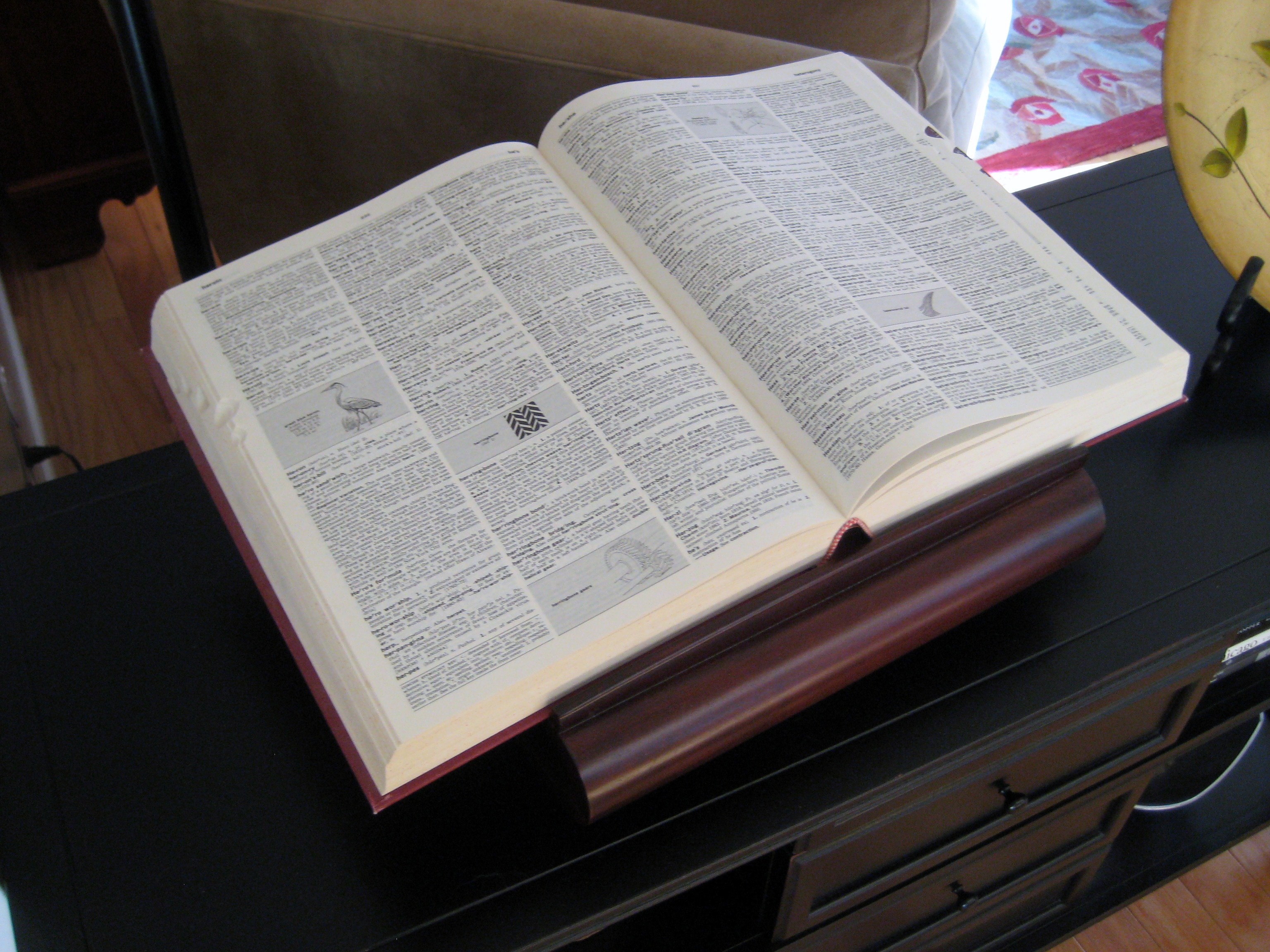
As nerdy word people, we tend to hang out with others in our tribe. When our geographic bonding crested into an emotional bonding, we decided to get married. Two valued members of the tribe pooled their resources to purchase the Random House Dictionary of the English Language, Second Edition, Unabridged. You can see it there in the photo. It’s a beauty, isn’t it? (That stunner still retails for about $200 new. Of course, you can pick up a well-thumbed copy for about $15.)

American Heritage Dictionary
Putting the dictionary on its pedestal

Aside from the very generous nature of the gift and the very appropriate relationship it had with our lives, there was the perfectly worded inscription on the card. “Because everybody needs a kick-ass dictionary for a wedding gift.” From that day to this, our family has called this tome the “Kick-Ass Dictionary.”

It sits on a swiveling pedestal under its own dedicated lamp. Right now it is open to the definitions ranging from “dept.” to “descendant.” Someone was looking up the spelling of “derailleur,” which is natural since recently we have been doing a lot of bike riding, a lot of working on bikes, and a lot of derailleur adjusting.

This dictionary – this kick-ass dictionary – occupies the same physical and spiritual space in our family that the Family Bible does in many other families. Our son’s friends once asked him how he had developed such a large vocabulary, and Sam responded by saying, “What’s the first thing you see when you come into our house? A dictionary.” (I wish he had said, “A kick-ass dictionary,” but not all anecdotes resonate precisely. Besides, he was 13 years old at the time and not yet comfortable using swear words in front of his parents.)

Twenty-two years after we married, the whimsical cereal bowls and the utilitarian carving set we also received as presents have long since expired. But the dictionary continues to give back. Everybody needs a kick-ass dictionary. Whether you’re getting married or not, it’s the perfect gift.

Define the Message

We live in a world of muddled messages. Politicians step on themselves to clarify missteps. Sports stars crank up the non-apology apology machine. Employers alienate their staff by reciting lawyerly pabulum to avoid litigation. And parents demonstrate the opposite of what they tell their children.

We send messages we don’t intend, and we hear things that weren’t meant. This disease of miscommunication and misunderstanding is not new, and we all succumb at some point.

I once delivered a conference presentation on some of the greatest research the home improvement industry has ever seen. I’m not a bad public speaker, but on this day, the slides didn’t work, my mouth malfunctioned, and my knowledge of the research was less than golden. At the end, the entire audience was in the fog of confusion, but none of them were as confused as I.

It gets worse.

I was the host for the conference, and I had to follow myself to the podium to introduce the next speaker, who was a top-notch pro. Before I brought him up, I reminded the audience to fill out their evaluation sheets so that we could ensure the previous speaker (me) never cast shadow on that stage again.

We all have our horror stories, but we can all define our messages with greater care and avoid the unintended meaning. We can implement strategies to make our communication – whether marketing, advertising, or employee manuals – clear and concise and without ambiguity.

6 Building Blocks of Effective Communication

And if we can define our messages, we can establish ourselves as leaders. I once worked for a very smart, very direct person who became quite powerful in the corporation. His simple gift was that he could cut through all the crap and put his finger on the one or two most salient points in any strategy. That clarity, that ability to jettison the distractions, gave him a focus that made other people want to follow.  When he talked, heads in the room nodded up and down.

That skill is such a common experience among successful people that it underlies 3 of the 7 habits Stephen Covey identified in his groundbreaking “The 7 Habits of Highly Effective People.”  #2: Begin with the end in mind. #3: Put first things first. #5: Seek first to understand, then to be understood.

Define your message and you can become the leader. Your message may be a personal message that establishes goals and articulates strategies to position you as a team leader. Your message may be a corporate brand that states your values and vision as a business, making you an industry or market leader. The underlying keys to success for both internal and external communication are the same.

  1. Listen to your audience
  2. Keep it simple
  3. Say it clearly
  4. Use it consistently
  5. Make it logical
  6. Appeal to common sense